“SING FOR MY PEOPLE TO HEAR” – A HEROIC ANTHEM OF DEVOTED WOMEN IN WHITE AO DAI
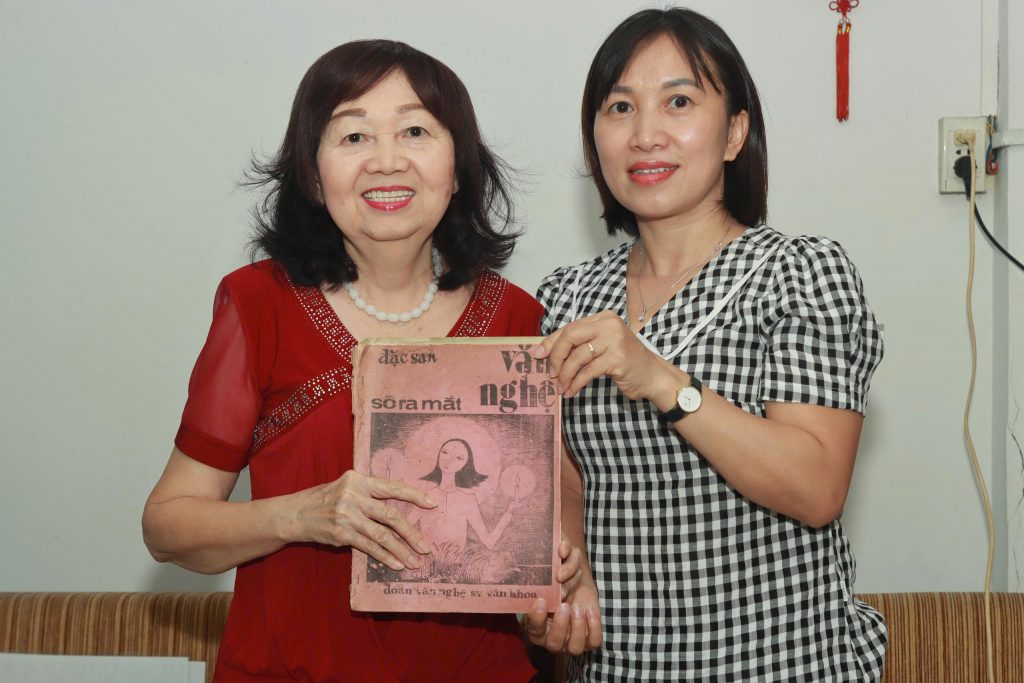
Ms. Le Thi Xuan Huong, a former student of the Faculty of Letters, presents to the Museum the “Van Nghe” bulletin of the Faculty of Letters Student Art Troupe.
When Music Awakens Conscience
In the years around 1965, Saigon entered a period of intense upheaval. The arrival of American expeditionary forces brought not only bombs and bullets but also a wave of pragmatic, foreign cultural influences. Sentimental and weakening “psychological warfare” songs were broadcast widely across radio stations and bars, aiming to lull the will and erode the ideals of the urban youth.
Amid this context, a group of students deeply committed to the nation’s destiny realized that to resist assimilation, they first had to safeguard the soul of the nation – its culture.
May 15, 1965, became a significant milestone with the official establishment of the Saigon Student – Pupil Art Troupe. This was not merely a talent club, but an organization of young people who used art as a weapon. Under the guidance of its core members, the movement began with a meaningful journey: “Returning to the roots.”
To counter foreign musical influences, students revived traditional folk songs. Familiar melodies such as Ly Ngua O, Trong Com, and Ba Ly resonated in lecture halls, carrying the spirit of a homeland rich in compassion and resilience.
Soon, the movement evolved into the genre of historical epic songs. Works celebrating the heroic victories of the nation – such as Bach Dang River, Lam Son Mountains and Rivers, The Flag of Co Lau, Dong Da Mound, Thang Long March, Chi Lang Pass, Dien Hong Conference, and Triumphal Song – were performed with immense national pride. These powerful melodies ignited determination and reminded every student that within them flowed the blood of heroes who would never submit to foreign domination.
The period from 1965 to 1967 marked a crucial preparatory phase. Cultural performances at the General Student Association and major high schools such as Chu Van An, Gia Long, and Le Hong Phong were no longer mere entertainment – they became spaces where political awareness was formed. Students began to understand that every song was a declaration against cultural invasion, a bond uniting those “moving forward” – young people ready to devote themselves to the ideal of national independence.
From this foundation of strong national consciousness, the “underground current” of music was poised to surge into powerful waves of street movements in the years that followed.
The Spirit of Tet Mau Than and the Anthem of the Streets
Continuing from this awakening, the period of 1967 – 1968 marked a decisive transformation. Singing was no longer just expression – it became a direct form of resistance within the urban heart.
By 1967, the war had escalated to its peak, with half a million American troops deployed in the South. Amid tear gas and the devastation of bombings across rural areas, urban youth could no longer remain contemplative. They faced the harsh reality and realized that earlier epic or resistance songs were no longer sufficient to reflect the urgency of the struggle.
From this necessity, the genre of “struggle songs” emerged. Musical poetry collections such as “Songs of Those Who Move Forward” by Tran Quang Long and “Singing from the Wilderness” by Mien Duc Thang directly denounced aggression and demanded the people’s right to live. The melodies grew sharper and more forceful, echoing the spirit of those confronting batons and tear gas: “Though the gas burns, we still carry our love for the nation; though it poisons, we still hold our humanity.”
Songs like “Rise Up” (Nguyen Xuan Tan), “Singing on the Road of Struggle” (Tran Long An), and “Oh Motherland, We Have Heard” (La Huu Vang) became rallying cries, uniting tens of thousands of students across Saigon, Hue, and Da Lat.
The most remarkable highlight of this period was the cultural night celebrating the Quang Trung Spring Festival on January 26, 1968 (the 25th day of Tet Mau Than). At the National School of Administration, despite heavy police presence, tens of thousands of students gathered under torchlight and red flags.
In that charged atmosphere, for the first time, the song “Sing for My People to Hear” by Ton That Lap was performed, electrifying the entire audience. The resounding chorus, joined by thousands of voices and clapping hands, transformed the event into a massive demonstration of unity. The song “Waiting for One Another”, expressing the longing for national reunification, pushed emotions to their peak, inspiring waves of students to move toward the frontlines.
In this era of “smoke and fire,” singing transcended the stage – it became a battle call, strengthening special forces and civilian resistance, contributing to the spirit of the General Offensive and Uprising of Tet Mau Than 1968 in the heart of the enemy’s stronghold.
At the Night of Music for Peace, held on December 27, 1969, at the University of Agriculture and Forestry in Saigon, the cultural movement of youth and students was officially named by the Saigon General Student Association as the movement “Sing for My People to Hear.”
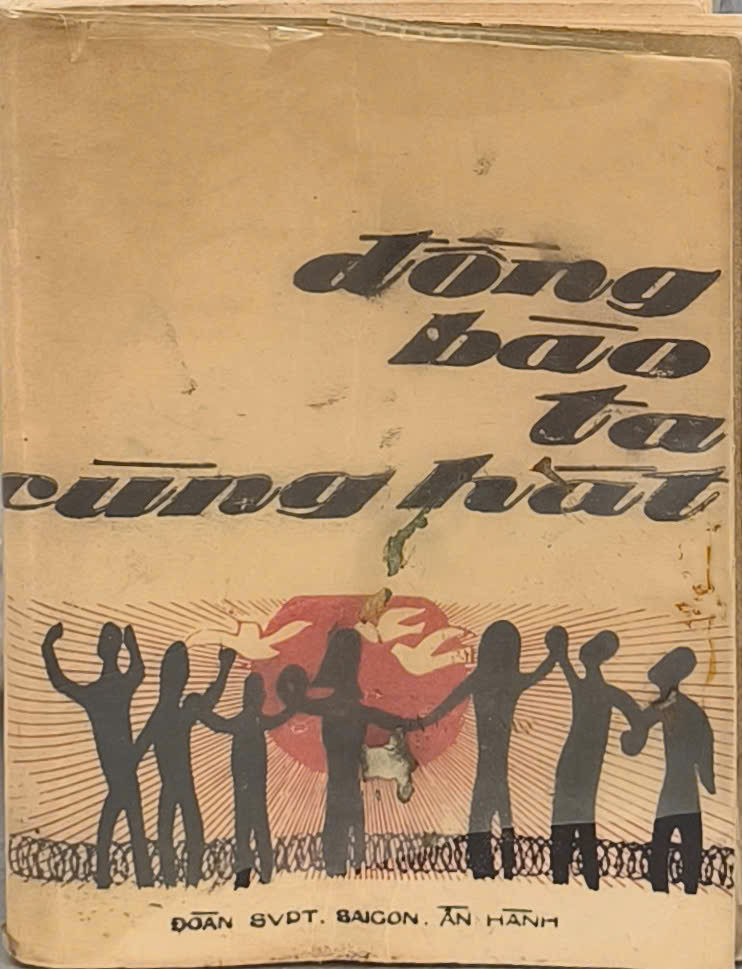
A publication issued by the Saigon Buddhist Student Association in 1971.
Songs Beyond Prison Bars
Following waves of mass demonstrations, the Saigon administration responded with harsh repression. Many movement leaders and key musicians were arrested and imprisoned in places described as “hells on earth,” such as Chi Hoa Prison, Con Dao, or solitary confinement cells at the Saigon Metropolitan Police headquarters. Yet the authorities were mistaken in believing that iron bars could silence these voices.
Within the cramped confines of “tiger cages” and “cow cells,” singing rose again as a source of life. Without instruments, students kept rhythm by tapping porcelain bowls and clapping their hands. These songs were not merely for solace – they became a means to preserve dignity, share information, and encourage one another to hold steadfast faith in eventual victory.
Many songs were composed in the darkness of prison. Notably, musician Ton That Lap wrote “Singing in Prison” in 1970 while held in solitary confinement. He later recalled that, during sleepless nights, the prison bars appeared to him like the lines of a grand musical staff. From there, melodies flowed, transforming physical suffering into unyielding spiritual strength.
The history of the student movement is marked by steadfast figures who became moral anchors for generations. One such figure was Le Minh Quoi, Secretary of the Saigon – Gia Dinh student movement (1957-1960). Despite imprisonment and brutal torture in Con Dao’s “tiger cages,” he remained resolute until his death in 1963. His spirit inspired later figures such as Le Hong Tu and Le Quang Vinh, who turned military courtrooms into platforms for revolutionary slogans, instilling fear in their oppressors.
The power of these songs also lay in their resonance beyond prison walls. As imprisoned students sang, their families and mothers outside would join in, creating a shared chorus of solidarity. Songs like “In Prison” and “Rise Up” erased the divide between freedom and captivity. They affirmed a profound truth: while the body can be confined, the will and the aspiration for peace cannot be imprisoned.
Songs that transcended prison bars became the clearest testament to the movement’s vitality, transforming prisons into new fronts of resistance – where patriotism triumphed over fear and death.
The Strength of the People and the Anthem of Reunification
The greatest strength of the movement “Sing for My People to Hear” lay not only in the young voices leading it, but also in the powerful resonance among the people and the support of international friends. These songs extended beyond university gates into working-class neighborhoods and marketplaces, forming an unprecedented front of unity.
By 1970, amid the fervor of street movements – such as the occupation of the Lon Nol Embassy in protest against massacres – songs like “The Mother of Ban Co” emerged from poetry by student Nguyen Kim Ngan and music by Tran Long An. The image of a mother “passing rice through forbidden walls” or a young woman “marrying a student” to deceive the enemy reflected the deep bond between the people and the student movement.
The movement spread across southern cities such as Hue, Da Nang, Can Tho, and Da Lat, and reached as far as France, Germany, and the United States. Patriotic songs of Vietnamese youth awakened global conscience and resonated with the international anti-war music movement of artists like John Lennon and Bob Dylan. This harmony generated strong public pressure, isolating the puppet regime and affirming the legitimacy of Vietnam’s struggle for independence.
When liberation forces entered Saigon on the morning of April 30, 1975, student voices were broadcast in the first announcement of the Revolutionary Committee. No song could better capture the joy of reunification than “Joining Hands in Unity” by Trinh Cong Son – a symbol of national triumph, where “flags join the wind” and “blood unites hearts.”
Seventy-six years since the traditional day of students and sixty-five years since the founding of the Saigon – Gia Dinh Liberation Student Association have passed, yet the spirit of “Sing for My People to Hear” remains an enduring flame of patriotism. These committed melodies continue to stand as a powerful lesson in cultural strength, solidarity, and the burning aspiration for freedom – guiding today’s and future generations in building a prosperous Vietnam.
Chu Văn Khánh